
Sciatica develops when a bulging or herniated disc compresses the sciatic nerve, radiating sharp pain, tingling, and numbness from the lower back down the leg. If symptoms persist beyond six weeks, a physical exam and MRI will be ordered to pinpoint the compression. Treatments range from physical therapy and medications to minimally invasive surgery, allowing Dr. Nkrumah to design a personalized plan that restores your comfort and mobility.
What Is Sciatica?
Sciatica is pain caused by irritation or pressure on the sciatic nerve, the longest nerve in the body, running from the lower back through the buttock and down the leg. Sciatica is not a diagnosis on its own, but rather a pattern of symptoms that points to an underlying cause in the spine, most often a herniated disc or narrowing around the nerve. Understanding the source of the pressure is the first step toward relieving it.
Symptoms of Sciatica
Common symptoms of sciatica include:
- Sharp or burning pain
- Paresthesia (tingling or “pins and needles”)
- Numbness
- Weakness
- Symptoms that grow more intense while moving
Patients with sciatica may experience symptoms anywhere along the sciatic nerve, including:
- Lower back
- Buttocks
- Legs
- Foot and toes
What Causes Sciatica?
A patient may experience sciatica when something is pressing or rubbing on the sciatic nerve, which runs from the lower back down each of the legs and into the heel of each foot. The name “sciatica” may also refer to pain running down the legs due to compression of any of the nerves in the lumbar spine. These nerves include the L4, L5, S1, S2, and S3 levels of the spine.
Common causes of sciatica include:
- A herniated disc
- Spinal stenosis
- Spondylolisthesis
- Back injury due to heavy lifting or repeated motion
- Natural degeneration of the spine over time (common in adults aged 30 and over)
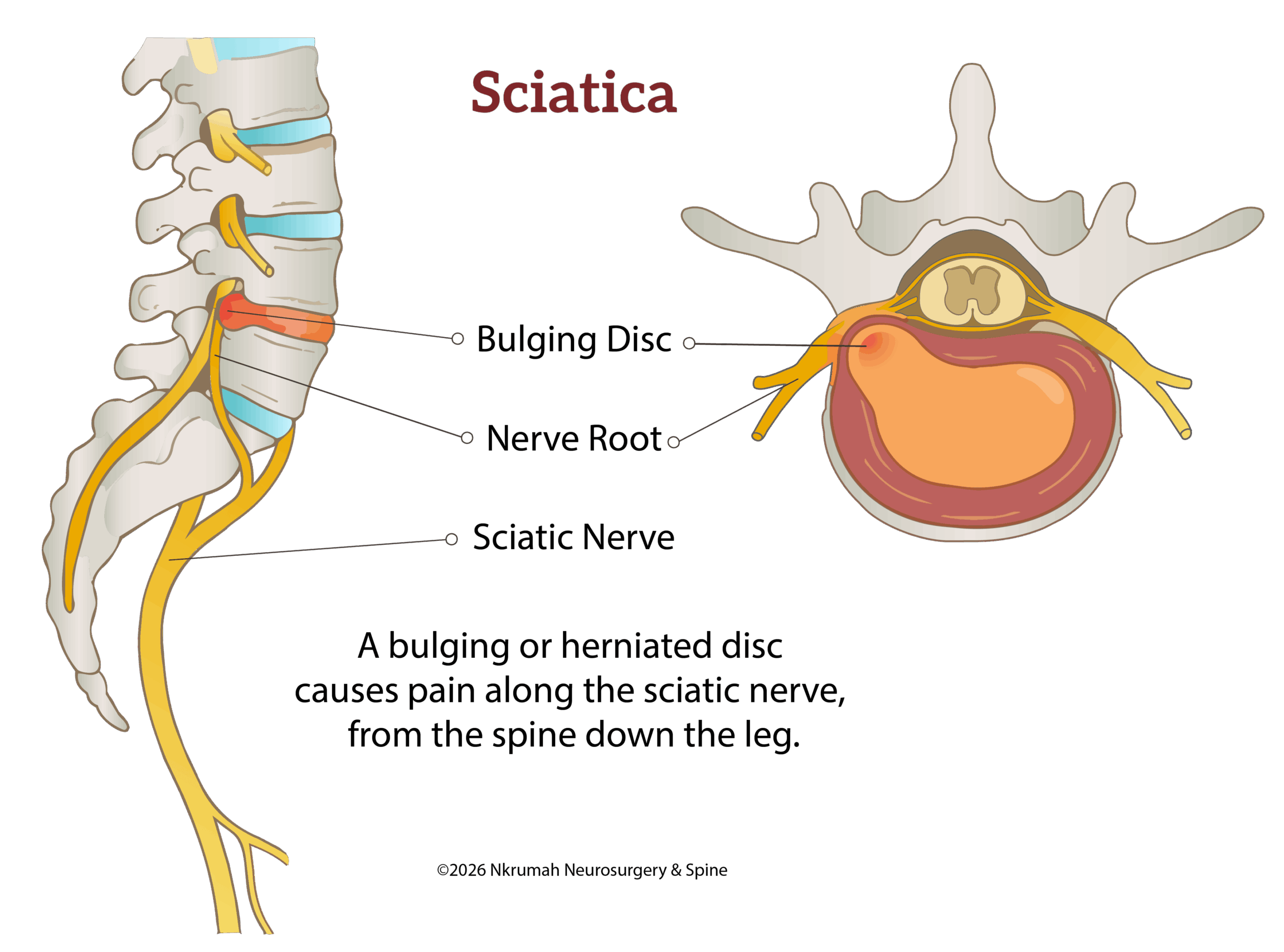
Please keep in mind that back pain without symptoms affecting the legs, buttocks, or feet likely isn’t sciatica but may still require medical attention.
Diagnosing Sciatica
If pain and/or numbness is severe or lasts longer than 6 to 8 weeks, speak with your doctor about your symptoms. In order to provide an accurate diagnosis, your doctor may conduct a physical examination and various tests to better understand your condition.
Tests to assist your doctor in diagnosing your condition might include:
- The Straight-Leg Raise (SLR) Test: The SLR test, also known as the Lasegue test, involves a physician gently raising the patient’s symptomatic leg to check for pain.
- The Crossed Straight Leg (XSLR) Test: An XSLR test is similar to an SLR test, except it is performed on the asymptomatic leg to see if the patient will feel pain on the symptomatic side.
- Imaging Tests: An MRI can reveal specific causes of sciatica, including what is causing the compression.

Why would I see a neurosurgeon for sciatica?
A neurosurgeon is uniquely trained to read an MRI and identify precisely which structures are involved, to what degree, and the risk of progression without treatment. He will also evaluate the symptoms you suffer from, observing how your pain affects the way you walk, sit and stand. An in-person appointment with Dr. Nkrumah may reveal hidden causes or contingencies other professionals may not know to look for.
When Dr. Nkrumah refers you to a chiropractor or a physical therapist, he advises that provider precisely which vertebrae and discs to focus on and where caution is warranted. See the surgeon first, so every aspect of your care plan is guided by the most thorough understanding of your condition.
Learn more about Louis John Nkrumah and his credentials here.
Treatment Options for Sciatica
Non-Surgical
- Medications: Your doctor may recommend over-the-counter or prescription medications to assist with pain control. Over-the-counter medications include NSAIDs (Non-Steroidal Anti-Inflammatory Drugs) such as ibuprofen (Advil, Motrin), naproxen (Aleve) or analgesics such as acetaminophen (Tylenol). Prescription medications include Gabapentin for neuropathic pain relief or muscle relaxants such as Cyclobenzaprine (Flexeril) and Methocarbamol (Robaxin).
- Physical Therapy: Physical therapy exercises may help relieve the pressure on the sciatic nerve, providing relief from symptoms.
- Spinal Injections: A steroid or corticosteroid injection into the spine, also known as an epidural, can provide temporary pain relief.
- Hot and Cold Therapy: Alternating between applying ice packs and heat packs to the affected area can reduce inflammation, pain, and other symptoms.
Surgical
- Non-Fusion Operations:
- Microdiscectomy: A minimally invasive procedure to remove herniated discs in the lower spine
- Endoscopic Spine Surgery: A minimally invasive procedure that uses a microscopic camera to decompress the spine
- Fusion Operations:
- Minimally Invasive Transforaminal Lumbar Interbody Fusion Surgery (MIS-TLIF): A minimally invasive procedure to remove a herniated disc and insert a spacer in its place
- Open Transforaminal Lumbar Interbody Fusion: Removes a herniated disc, replacing it with a spacer, screws, and/or rods as needed
Which Sciatica Treatment Option Is Best for Me?
Each patient and situation is unique. Your cause of sciatica, severity of symptoms, lifestyle, and preferences will all play a role in determining the best course of action.
At Nkrumah Neurosurgery, Dr. Nkrumah will spend at least an hour getting to know your case, explaining the various treatment options, and providing detailed recommendations and answers to your questions. Together, you will determine a treatment plan that works for you, and you will have choices every step of the way to make your experience as comfortable as possible.
For any questions or to schedule an appointment, contact our office by calling (631) 525-1420 or send us a message online.
Sources:
https://www.ncbi.nlm.nih.gov/books/NBK507908/
https://www.medicalnewstoday.com/articles/7619
https://www.nhs.uk/conditions/sciatica/
https://www.ncbi.nlm.nih.gov/books/NBK539717/
Dr. Nkrumah was the blessing I needed. I was experiencing severe sciatica and lower back pain that landed me in the hospital. I was unable to walk and had indescribable pain. Before my surgery, he explained in detail the procedure and helped ease the mind of my partner and parent, who were nervous about the surgery. The surgery was successful, and I felt extremely better by the next day. Three months after surgery, I walk as if I never had back issues or underwent surgery.
I could not be more grateful for Dr. Nkrumah walking into my hospital room when he did. Great surgeon and a kind individual. I highly recommend.
—Darlene M., November 2024


